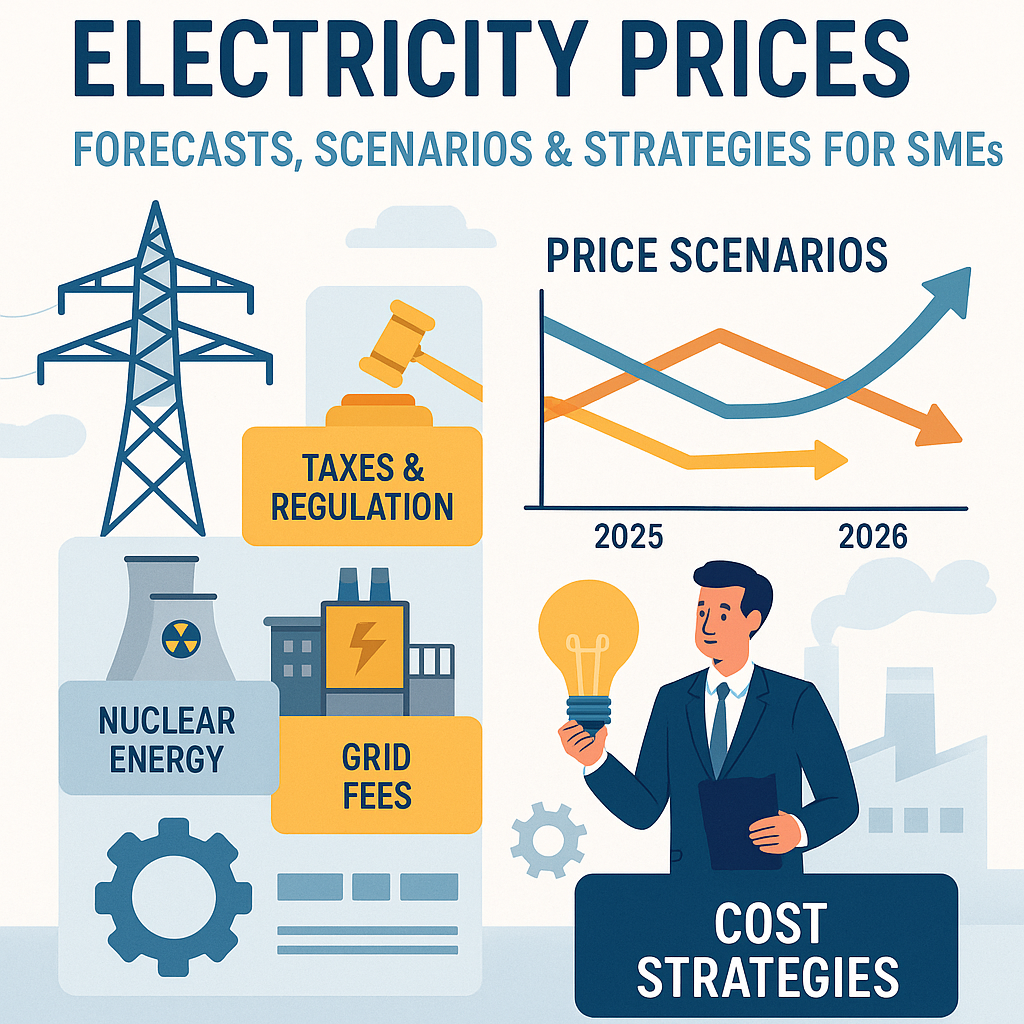
EDF’s Blue Tariff, the historical pillar of electricity supply for many French VSEs and SMEs, is at a decisive turning point in 2025. Faced with the continuous liberalization of the energy market, a burning question is on the lips of many managers: is their company still eligible for this regulated tariff? The answer, far from being simple, requires a detailed analysis of the current criteria and an understanding of the alternatives now available. This article, written by the experts at EnergyProMag.com, offers you a complete and actionable analysis to navigate this complex energy landscape, secure your supply, and optimize your costs.
The Linky meter, a key tool in managing the energy consumption of professionals.
Table of Contents
The EDF Blue Tariff: Portrait of a Historic Offer
The Blue Tariff is the regulated sales tariff (TRV) for electricity, marketed by the historical supplier EDF. Designed as a protective shield for individuals and the smallest professional structures, its price is set by the public authorities, on the proposal of the Energy Regulation Commission (CRE). It thus differs fundamentally from market offers, whose tariffs are freely determined by each supplier.
Historically, the French energy landscape had three regulated tariffs for professionals:
•The Blue Tariff: for subscribed powers up to 36 kVA.
•The Yellow Tariff: for powers between 37 and 250 kVA (discontinued in 2016).
•The Green Tariff: for powers above 250 kVA (discontinued in 2021).
Today, only the Blue Tariff remains for an increasingly restricted category of professionals. It embodies a form of public energy service, aiming to offer visibility and tariff stability in the face of sometimes brutal fluctuations in wholesale markets.
Marc Delhaye, editor-in-chief of EnergyProMag: “The Blue Tariff has long been a matter of course for artisans and merchants. In 2025, it is becoming an exception. Considering it as the only or the most economical option is a strategic error that can be costly. The real skill now lies in the ability to compare and arbitrate.”
Are you still eligible in 2025? A closer look at the criteria
Access to the regulated tariff for professionals is subject to very strict cumulative conditions, aligned with the European definition of a micro-enterprise. To benefit from the Blue Tariff in 2025, your company must imperatively meet the following three thresholds:
1.Subscribed power: Your meter must display a power less than or equal to 36 kilovolt-amperes (kVA).
2.Workforce: You must employ fewer than 10 employees (in full-time equivalent).
3.Financial health: Your annual turnover or your total balance sheet must be less than 2 million euros.
If a single one of these criteria is exceeded, the company automatically loses its eligibility and must turn to a market offer.
Infographic: Test your eligibility in 3 steps
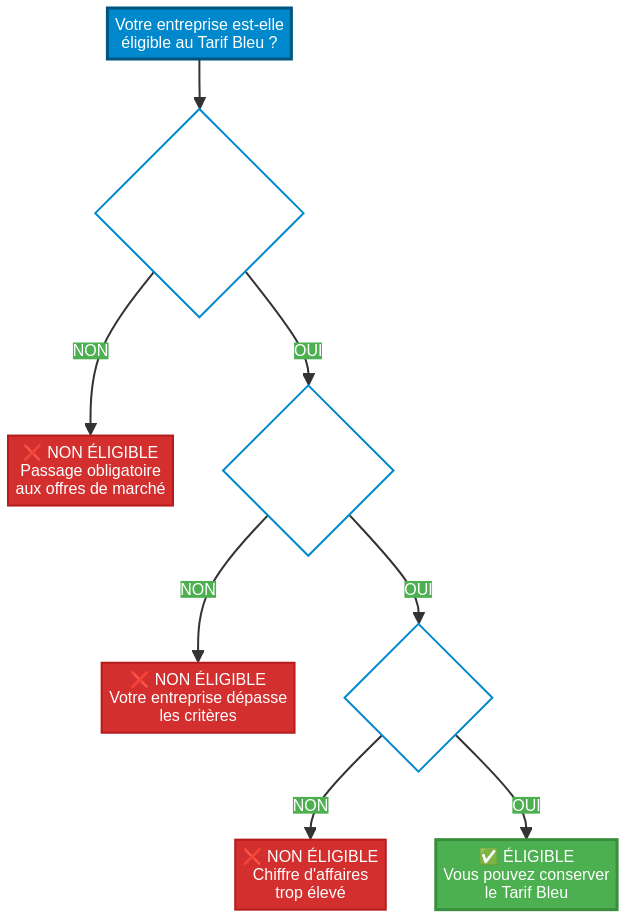
A simple diagram to quickly check if your company can still claim the regulated tariff.
Concrete examples of generally eligible companies:
•An artisanal bakery with 4 employees.
•A law firm with 2 partners and a secretary.
•A retail business (florist, bookseller) with a small sales area.
•An independent consultant working from his office.
How to check? The easiest way is to consult your last electricity bill: the subscribed power is clearly indicated there. Cross-reference this information with your latest tax return and your personnel records. In case of doubt, the support of an energy broker can provide you with a precise and free diagnosis.
Blue Tariff vs. Market Offers: The Comparison Match
The choice between keeping the Blue Tariff and switching to a market offer is a major strategic decision. To help you see more clearly, here is a detailed comparison table of the two options.
| Criteria | Blue Tariff (Regulated) | Market Offers |
| Price Setting | Regulated by the state (via the CRE) | Free, set by the supplier |
| Tariff Evolution | Periodic revisions (usually twice a year) | Depends on the contract: fixed, indexed, or dynamic (spot) price |
| Stability | Medium (subject to political decisions and taxation) | High for fixed prices, variable for others |
| Competitiveness | Increasingly less competitive against promotional offers | Potential savings of 10 to 15% depending on the profile |
| Commitment | No commitment, terminable at any time | Commitment of 1 to 4 years, sometimes with penalties |
| Return Possible? | NO, any exit is final | Change of supplier possible at the end of the contract |
| Suppliers | EDF only | Over 30 suppliers (TotalEnergies, Engie, Vattenfall, etc.) |
The Blue Tariff is no longer a guarantee of savings
Contrary to popular belief, the regulated tariff is no longer systematically the most advantageous. According to the latest CRE observatories, a growing share of market offers proposes more competitive tariffs. The potential savings strongly depend on your consumption profile and your ability to negotiate.
Infographic: Simulation of annual savings
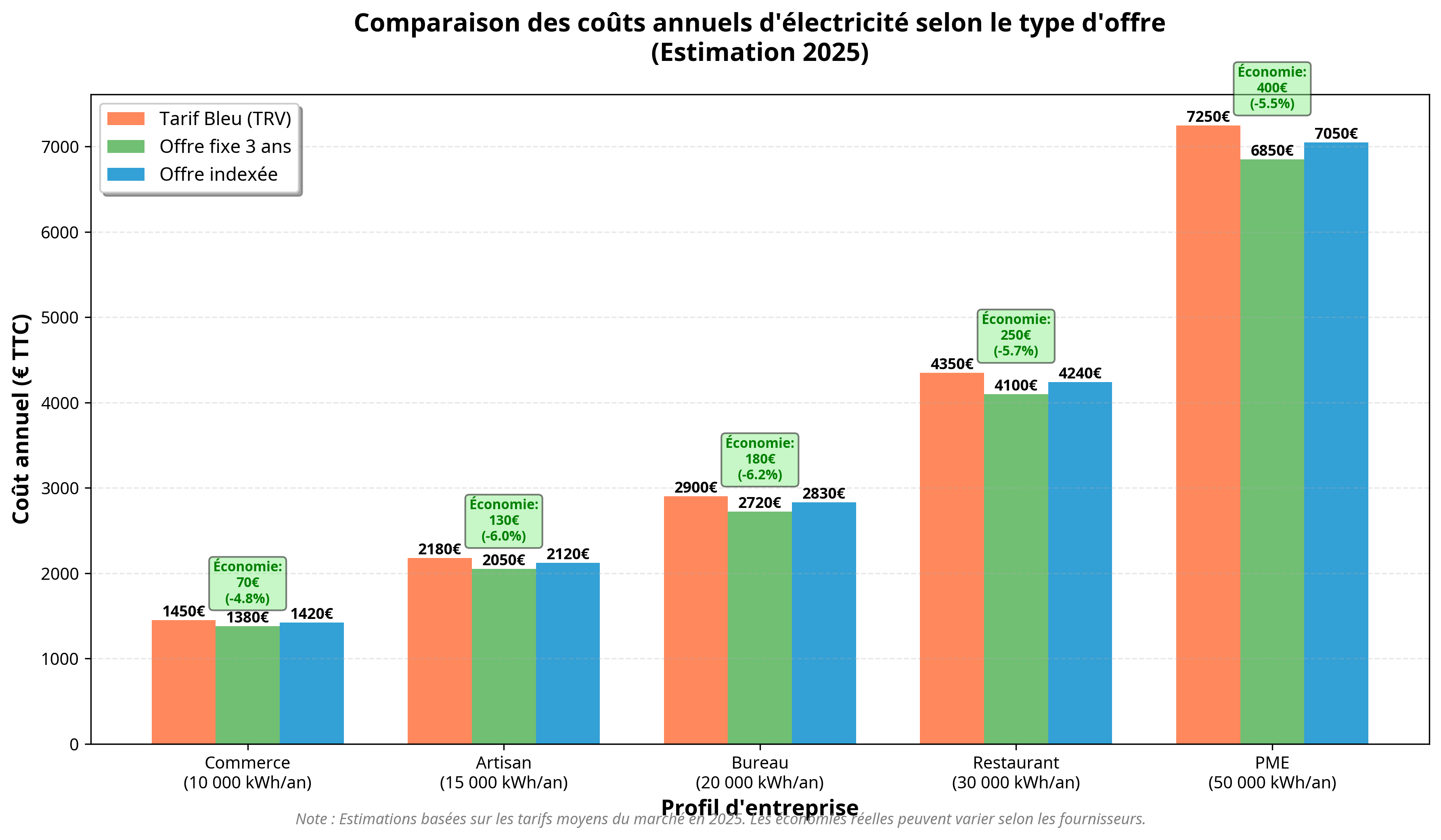
This simulation shows the potential savings by switching to a market offer for different VSE profiles.
The Inevitable Erosion of the Blue Tariff: Why Are Fewer and Fewer Companies Concerned?
The decrease in the number of companies eligible for the Blue Tariff is not a coincidence, but the result of a European policy of liberalizing energy markets. The objective is to stimulate competition, encourage innovation, and allow consumers to become actors in their consumption.
Several factors explain this underlying trend:
•The natural growth of companies: By developing, a VSE can exceed the threshold of 10 employees or 2 million euros in turnover.
•The increase in power needs: The modernization of equipment (machines, servers, electric vehicles) is pushing many companies to increase their subscribed power beyond 36 kVA.
•Market dynamics: Alternative suppliers, with aggressive commercial strategies and innovative offers (green offers, consumption monitoring services), are attracting more and more professionals.
Infographic: The free-falling share of the Blue Tariff
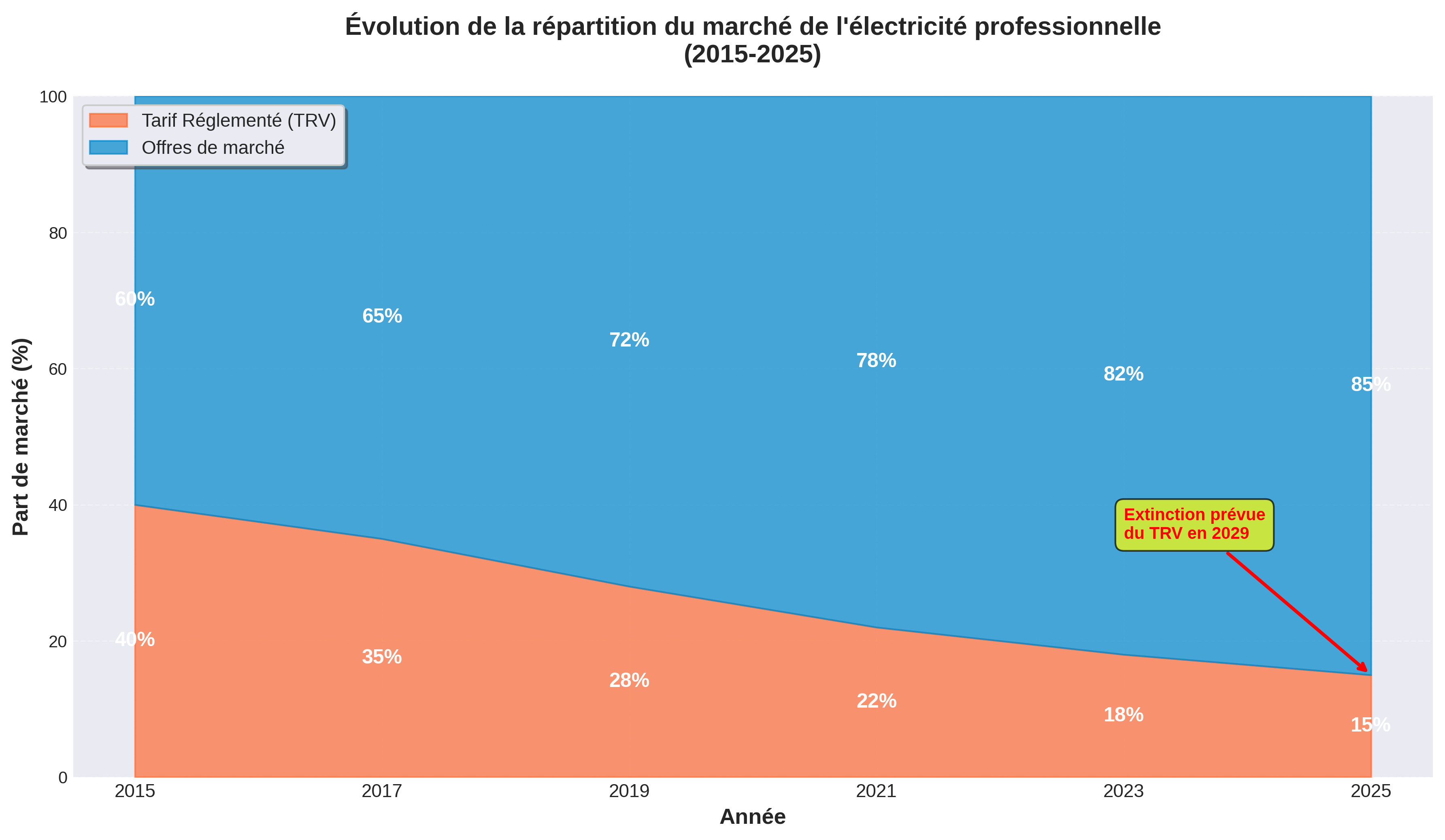
This graph clearly illustrates the decline in the share of the regulated tariff among professionals between 2015 and 2025.
What are the alternatives to the Blue Tariff in 2025?
The liberalized market is full of options that may be much better suited to your business than the regulated tariff. Here are the three main families of offers to consider.
1. Fixed-price offers: Security first and foremost
The principle is simple: the price of your kilowatt-hour (kWh) is blocked for the entire duration of the contract (from 1 to 4 years). This is the ideal solution for companies looking for total budgetary visibility and wishing to protect themselves against market volatility. In times of rising prices, it is a real bulwark.
2. Indexed-price offers: The bet on flexibility
Here, the price of your kWh evolves according to a reference index. It can be:
•The Blue Tariff itself: You benefit from a guaranteed percentage reduction compared to the regulated tariff.
•The wholesale market (Epex Spot): Your price varies every day or every month. This is a riskier option, but it can be very advantageous when market prices are low. It is recommended for companies with a good knowledge of the sector.
3. Green offers and PPAs: The sustainable commitment
More and more suppliers are offering green electricity offers, guaranteeing that the equivalent of your consumption is injected as renewable electricity into the network. To go further, Power Purchase Agreements (PPAs) allow you to contract directly with a renewable energy producer (solar, wind) over the long term, often at very competitive prices.
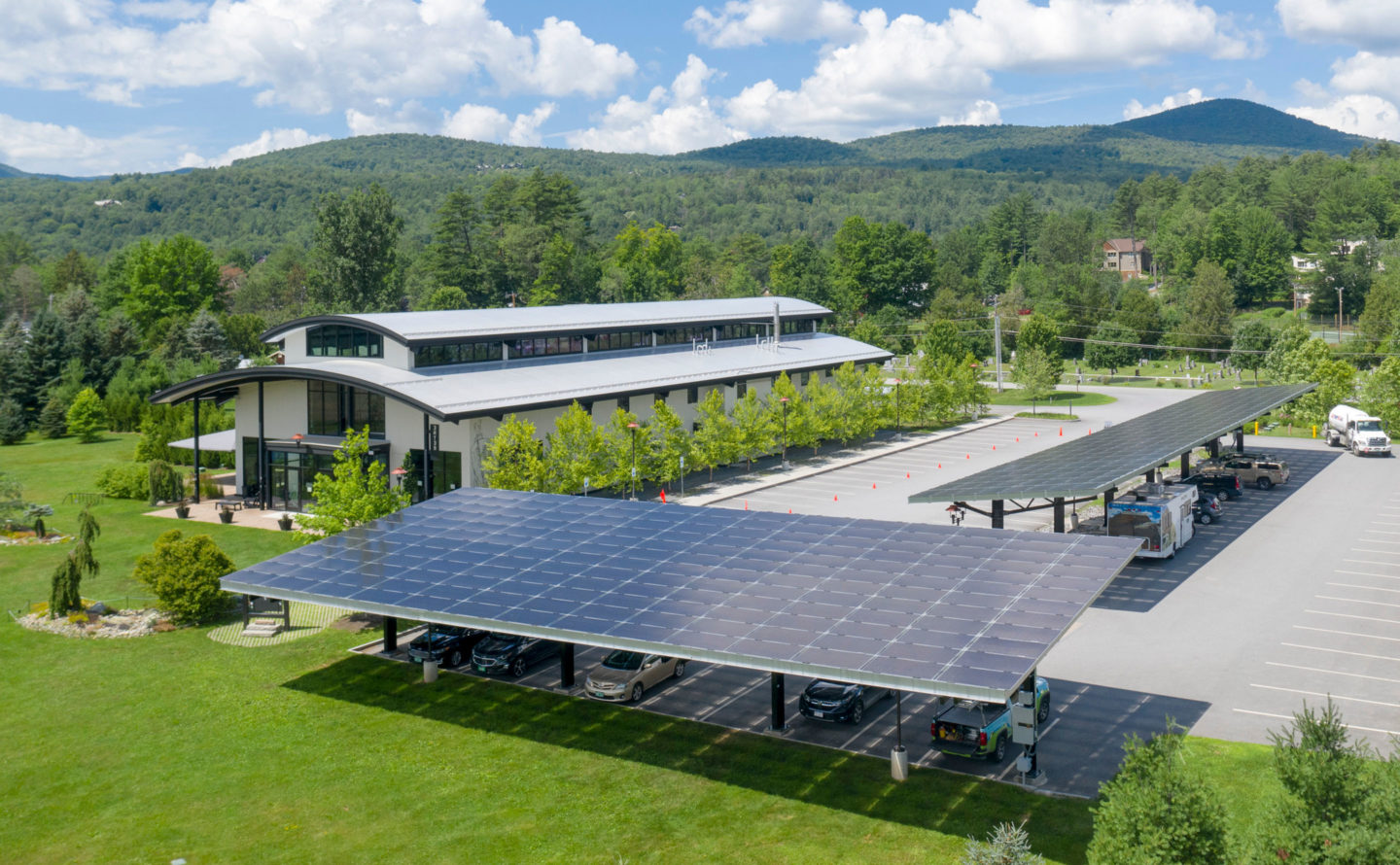
PPAs allow companies to source renewable energy directly, an asset for their CSR approach.
Comparison table of alternative suppliers
| Supplier | Specificity | Majority of offer types | Ideal for… |
| TotalEnergies | Large group, wide range of offers | Fixed and indexed | Companies looking for a recognized supplier |
| Engie | Historical gas supplier, major player in electricity | Fixed and indexed | Customers wanting a single contact for gas + electricity |
| Vattenfall | European player, focus on carbon neutrality | Fixed and indexed | Companies sensitive to environmental commitment |
| Ekwateur | Alternative and collaborative supplier | Green offers, PPAs | Start-ups and innovative companies |
| Opéra Energie | Energy broker | Access to all market offers | Companies wanting personalized support |
How to leave the Blue Tariff with peace of mind? The practical guide
Abandoning the regulated tariff is a simple process, provided you are methodical. Here is the roadmap for a successful transition.
Infographic: The step-by-step supplier change process
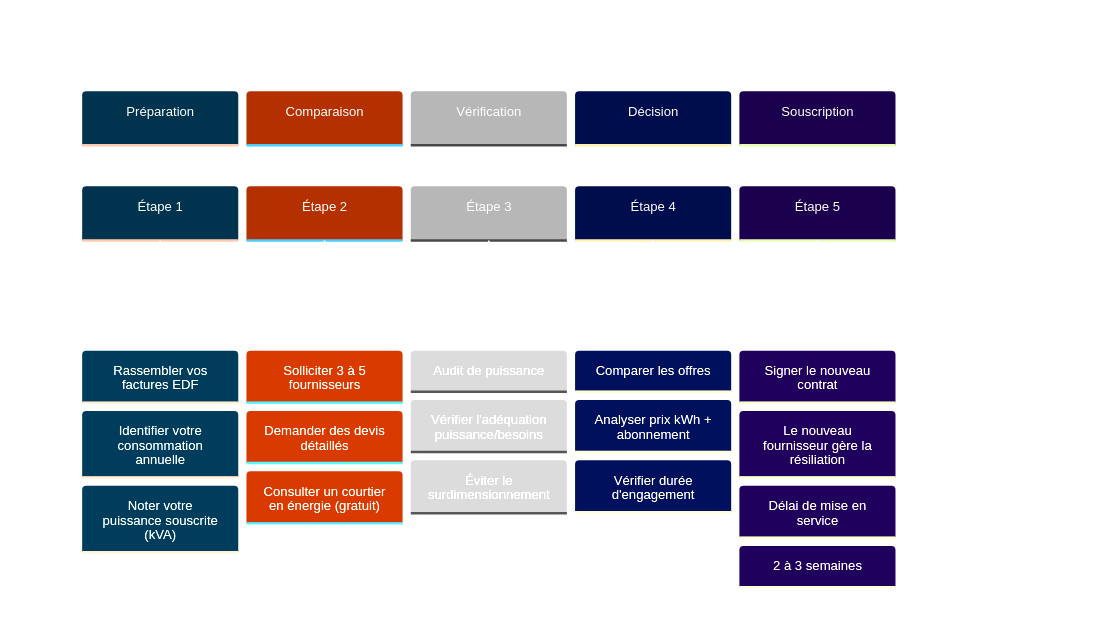
Follow these steps for a smooth and seamless transition.
Crucial warning: The decision to leave the Blue Tariff is irreversible. You will not be able to return to it, even if your activity slows down and you become eligible again. This decision must therefore be carefully considered.
Will the Blue Tariff disappear? Chronicle of an announced end
The question is no longer if the professional Blue Tariff will disappear, but when. All regulatory signals, at both French and European levels, converge towards a programmed extinction.
Provisional timetable for the disappearance of the professional regulated tariff
| Period | Event | Impact for companies |
| 2025-2026 | Maintenance of the status quo | Eligible companies can still benefit from it |
| 2027-2028 | Official announcement of the end of the regulated tariff | Transition period to allow companies to change contracts |
| 2029 | Definitive extinction | All companies, without exception, will have to have a market offer |
This disappearance will force the last companies still on the regulated tariff to delve into the market. For the most prepared, it will be an opportunity. For others, the risk of a sudden increase in bills is real. Anticipation is therefore the key.
FAQ – Answers to your questions about the Blue Tariff
Can I return to the Blue Tariff after leaving it?
No, it’s impossible. The regulations are formal: any exit from the regulated sales tariff is final. This is why this decision must be made after a thorough analysis of the alternatives.
Is the Blue Tariff still the cheapest in 2025?
Absolutely not. This is one of the most persistent misconceptions. In 2025, many market offers, especially during promotional periods, offer rates 10 to 15% lower than the regulated tariff. The only way to know is to compare.
How do I know if I am on the Blue Tariff or a market offer?
The information is clearly indicated on the first page of your electricity bill. The name of the offer is specified there (e.g., “Blue Tariff”, “2-year fixed offer”, etc.) as well as the name of your supplier.
Does the Blue Tariff exist for gas?
No, not anymore for professionals. The regulated sales tariffs for gas were completely abolished for all professionals in July 2023. All companies must now subscribe to a market offer for gas.
Conclusion: Anticipate to better control your energy bill
The EDF Blue Tariff, once a universal benchmark, is now an endangered species in the professional energy landscape. The year 2025 marks a new stage in its decline, making it more restrictive and often less competitive. For the managers of VSEs and SMEs, waiting is no longer a viable option.
The transition to market offers, far from being a threat, represents a formidable opportunity for optimization. It requires a proactive approach: auditing your needs, comparing suppliers, and choosing a tailor-made offer that combines tariff competitiveness and adapted services. Tools like online comparators and the support of energy brokers are valuable allies in this process.
The announced end of the Blue Tariff is not a fatality, but an invitation to regain control of your energy expenses. By acting now, you will transform this regulatory constraint into a performance lever for your company.
Don’t wait until 2029 to act. Compare your electricity offers today and get a head start.