CEE Enterprise 2025: Premium Calculator + Complete Guide

Introduction
Do you know how much your company can earn thanks to the Energy Savings Certificates (Certificats d’Économies d’Énergie – CEE)? In a context of rising energy costs and increased regulatory pressure, CEEs represent much more than just aid: they are a real opportunity for profitable investment. This complete guide, accompanied by a free calculation tool, gives you all the keys to transform your obligations into a lever for competitiveness. Discover how to calculate and obtain your CEE premiums simply.
👉 Launch the CEE calculator now.
What is a CEE and why is it a Strategic Opportunity?
The Energy Savings Certificates (CEE) scheme is one of the main instruments of France’s energy demand management policy. Launched in 2005 by the POPE law, it is based on the “polluter pays” principle and requires energy and fuel suppliers (the “obligated parties“) to achieve energy savings, under penalty of financial penalties. To do this, they encourage their customers – companies, local authorities, and individuals (the “beneficiaries“) – to carry out energy renovation work by paying them premiums.

The national objective is ambitious, measured in TWh cumac, a unit that quantifies energy savings over the lifespan of the equipment. For companies, the CEE scheme represents a strategic opportunity on several levels:
Financing Investments: CEE premiums can cover a significant portion of the work cost, thus reducing the Return on Investment (ROI).
Reducing Energy Bills: By improving their energy efficiency, companies permanently decrease their electricity and gas expenses.
Asset Valuation: More efficient premises are more attractive and see their value increase.
CSR Commitment: Participating in the energy transition strengthens the company’s brand image and societal commitment.
The CEE Journey: From Renovation to Premium

The journey of a CEE, from the renovation decision to the receipt of the premium, is a structured process involving several actors, including the delegates (Délégataires), specialized intermediaries who support beneficiaries in their procedures.
How does the CEE Calculation Work?
The calculation of the CEE premium amount is based on a specific unit of measurement: the kWh cumac (cumulated and actualized). This unit represents the quantity of energy saved over the entire lifespan of a piece of equipment, taking into account its natural wear. The basic formula is as follows:
$$\text{CEE Amount (in kWh cumac)} = \text{Annual Savings (in kWh)} \times \text{Equipment Lifespan (in years)} \times \text{Actualization Coefficient}$$
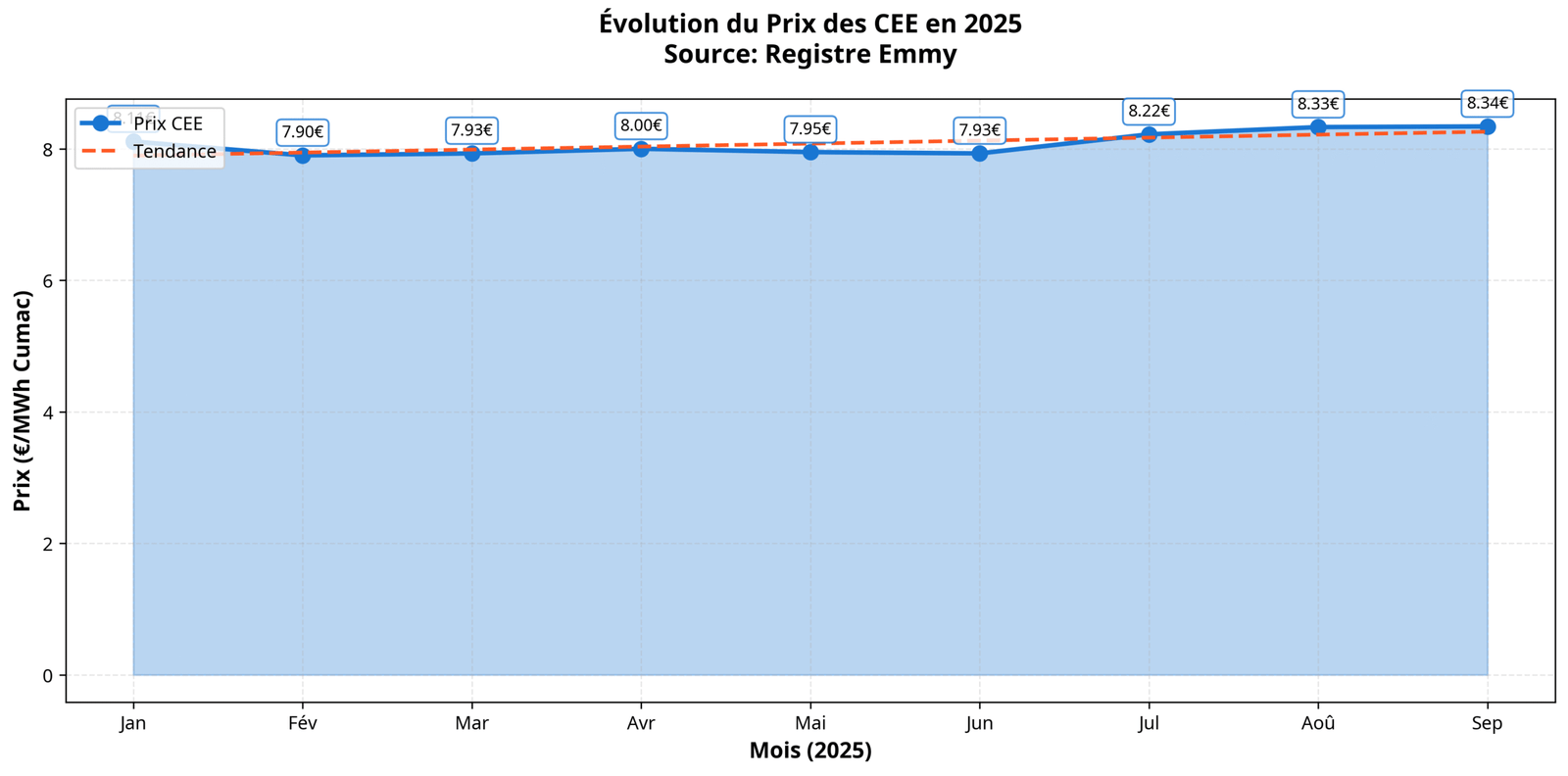
The actualization coefficient, fixed at 4% per year, allows for the weighting of future energy savings. The value of one kWh cumac in euros fluctuates according to supply and demand on the CEE market. In September 2025, it was approximately €8.34/MWh cumac [1].
CEE Price Evolution in 2025
Several variables influence the volume of kWh cumac generated by an operation:
Type of Work: Each operation is defined by a “standardized operation sheet” which specifies the technical conditions and the fixed amount of energy savings.
Sector of Activity: The sheets are classified by sector (industry, tertiary, residential, agricultural, etc.), with requirements adapted to each context.
Climate Zone: For insulation or heating work, the company’s geographical zone is taken into account.
Concrete Example: Replacing an oil boiler with a high-performance heat pump in a 500 m² tertiary building in zone H1 can generate several hundred thousand kWh cumac, translating into a premium of several thousand euros.
Examples of Average CEE Amounts per Operation
| Type of Operation | Sector | Average CEE Premium Amount |
| Roof Insulation | Industry | Up to €30/m² |
| Heat Recovery on a Cooling Production Unit | Industry | ROI often less than 2 years |
| Replacement of Lighting Fixtures with LEDs | Tertiary | Variable according to surface area and power |
| Installation of a BMS (Building Management System) | Tertiary | Up to 50% of the equipment cost |
💡 Simulate your premiums with our CEE Calculator
To get a precise and instant estimate of your CEE premium amount, use our interactive calculator. In a few clicks, select your sector of activity and the type of work envisaged to discover the potential amount of your aid. You can also receive a detailed report by email to refine your project.
Our CEE calculator is constantly updated to reflect the latest standardized operation sheets in force, including the evolutions planned for the 6th period (P6) from 2026-2030.
👉 Launch the simulation now
The 10 Most Profitable CEE Works for Companies
Certain energy renovation operations offer a particularly fast return on investment thanks to CEE premiums. Here is a ranking of the most profitable works for companies in 2025:
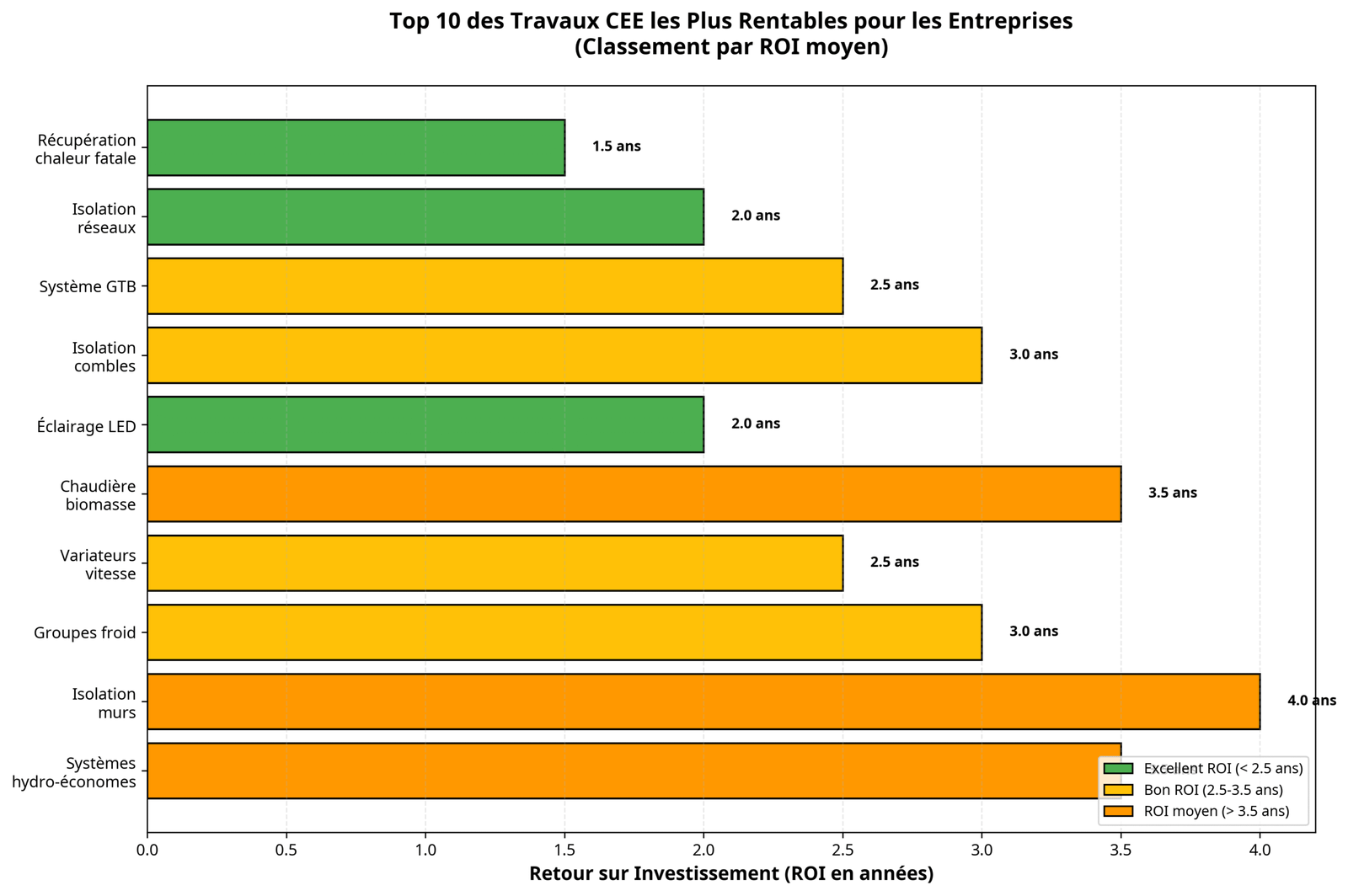
| Rank | Operation | Sector(s) | Profitability and Advantages |
| 1 | Fatal Heat Recovery | Industry | Very fast ROI (< 2 years), recovery of lost energy. |
| 2 | Insulation of Singular Points on a heating or cooling network | Industry, Tertiary | Low investment, immediate gains on heat loss. |
| 3 | Installation of a Building Management System (BMS) | Tertiary | Real-time consumption optimization, eligible for a bonus. |
| 4 | Insulation of Attics and Roofs | All | Drastic reduction in heating and cooling needs. |
| 5 | Replacement of Lighting Fixtures with High-Performance LED | All | Up to 80% savings on the lighting expense. |
| 6 | Installation of a High-Performance Biomass Boiler | Industry, Tertiary, Agricultural | Sustainable alternative to fossil fuels, strongly supported. |
| 7 | Installation of Variable Speed Drives on electric motors | Industry | Precise adjustment of consumption to production, significant gains. |
| 8 | Renovation of Cooling Production Units | Industry, Tertiary | Improved efficiency, reduced refrigerant fluid leaks. |
| 9 | Wall Insulation | All | Improvement of comfort and overall building performance. |
| 10 | Installation of Water-Saving Systems | Tertiary | Significant reduction in domestic hot water consumption. |
Illustrations of Eligible Works

Example of roof insulation – One of the most cost-effective jobs

Replacement with LED lighting – Immediate savings on your electricity bill
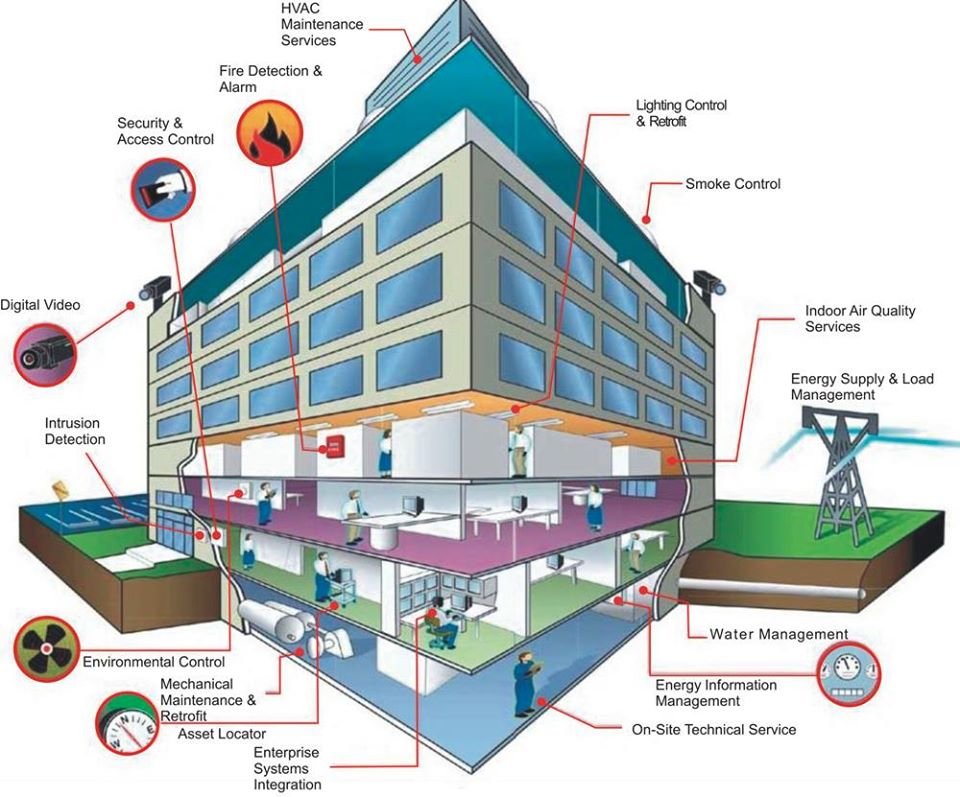
GTB system – Intelligent optimization of energy consumption
For a comprehensive list, you can consult the 247 eligible project sheets on the website of the Ministry of Ecological Transition [2].
Steps to Obtain Your CEEs (Average Time: 3 to 6 months)
Obtaining CEE premiums follows a rigorous process. Compliance with each step is imperative to ensure the validation of your application.
CEE Journey Timeline
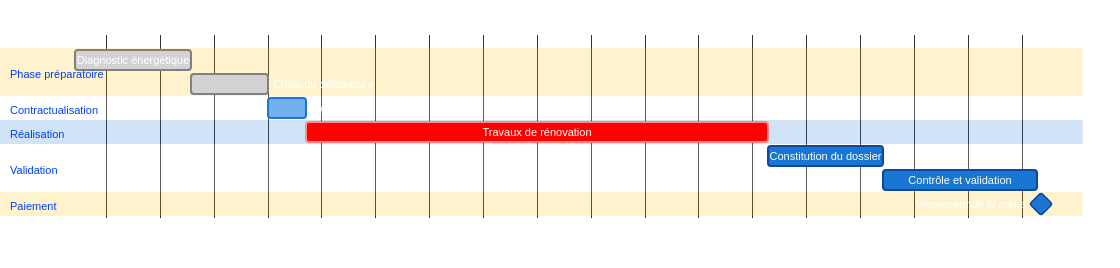
Diagnosis and Choice of Provider: Before any commitment, identify energy saving opportunities and choose a partner (obligated party or delegate) to support you.
Signing the Quote BEFORE the Work: This is a sine qua non condition. The quote must be signed after your application has been accepted by the CEE partner. Any premature signing cancels eligibility.
Execution of Work: The work must be carried out by a qualified professional, ideally RGE certified (Recognized Guarantor of the Environment), and strictly comply with the requirements of the standardized operation sheet.
Preparation and Submission of the File: Gather all supporting documents (quotes, invoices, affidavit, etc.) and transmit them to your partner.
Control and Payment of the Premium: After verifying the conformity of the work (sometimes via an on-site control), the file is validated and the premium is paid to you, generally in the form of a bank transfer or a deduction on the invoice.
Frequent Mistakes to Avoid (and how to correct them)
The process of obtaining CEEs is fraught with pitfalls. A single error can jeopardize the payment of the premium. Here are the most common traps:
Signing the quote before the CEE partner’s agreement: This is the most frequent and most prohibitive error. Solution: Never sign a quote before having a formal contract with an obligated party or a delegate.
Choosing non-compliant equipment: The standardized sheets impose very precise performance criteria. Solution: Verify that the equipment references proposed on the quote exactly match the requirements of the sheet.
Hiring an unqualified tradesperson: The absence of RGE certification (when required) invalidates the file. Solution: Systematically demand the installer’s qualifications.
Incomplete or improperly filled out file: A poorly completed affidavit or a missing invoice can lead to months of delay. Solution: Be accompanied by a broker or a delegate who takes charge of the administrative management.
Checklist: 5 Points to Check Before Starting a CEE Project
✅ Check 1: The quote has not been signed yet
✅ Check 2: The CEE partner has validated your file
✅ Check 3: The equipment meets the criteria of the standardized sheet
✅ Check 4: The installer has the required certifications (RGE if necessary)
✅ Check 5: All supporting documents are ready
2025 Comparison: The Main CEE Delegates
Delegates are specialized actors, mandated by the obligated parties for the management and collection of CEEs. Choosing the right partner is crucial. Here are some of the main delegates active in 2025. This comparison is purely informative and non-sponsored.
| Delegate | Specialization | Average Valuation Rate | Average Payment Time |
| Opéra Energie | Multi-specialist Broker (Industry, Tertiary, Co-ownership) | Competitive (via competitive bidding) | 30-60 days after validation |
| Hellio | Global energy management player | Variable | 60-90 days |
| Adeo | Specialized in residential and small tertiary | Variable | 60-90 days |
| Economie d’Energie | Digital platform and support | Variable | 45-75 days |
| GEO PLC | Specialist in global renovation | Variable | 60-90 days |
The choice of a delegate should not be based solely on the valuation rate, but also on the quality of support, responsiveness, and administrative reliability. An energy broker can help you compare the offers of delegate partners for free.
CEE and Other Cumulative Schemes
One of the great advantages of CEEs is their possible accumulation with other aids, allowing you to maximize the financing of your projects.
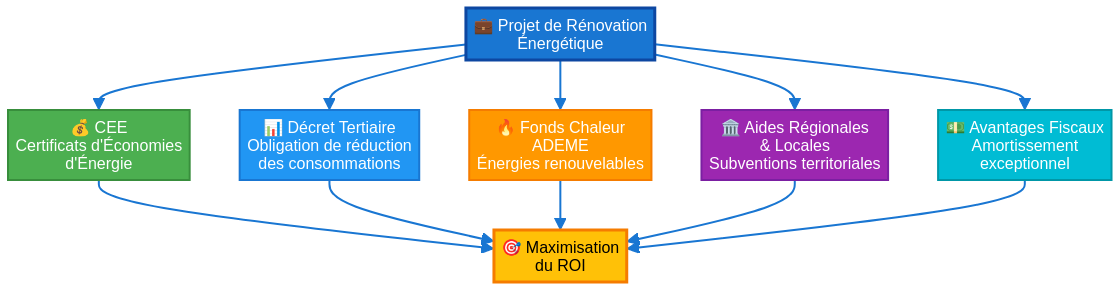
Tertiary Decree (Décret Tertiaire): Actions taken to achieve the objectives of the Tertiary Decree are often eligible for CEEs. The combination of the two schemes is an essential lever for financing the renovation of tertiary buildings.
ADEME Heat Fund (Fonds Chaleur): For renewable heat production projects (biomass, geothermal, solar thermal), the Heat Fund can be accumulated with CEEs, under certain calculation conditions.
Regional and Local Aids: Many regions and local authorities offer subsidies for energy renovation, often cumulative with CEEs.
Tax Advantages: Certain investments may also qualify for exceptional depreciation or tax credits.
It is crucial to properly structure your financing plan upstream to articulate these different aids and optimize the return on investment.
Frequently Asked Questions (FAQ)
What is a CEE for a company?
An Energy Savings Certificate (CEE) is a document that attests to the realization of an energy saving action. For a company, it is the means to obtain a premium to finance its energy renovation work, paid by an energy supplier (“obligated party”).
How to calculate the CEE amount?
The amount is calculated in kWh cumac, a unit that depends on the annual energy gain, the equipment’s lifespan, and an actualization coefficient. Standardized operation sheets define fixed amounts for each type of work.
Who can benefit from CEEs?
All companies, regardless of their size and sector of activity (industry, tertiary, agricultural, etc.), as well as local authorities and individuals, can benefit from CEE premiums.
How long does it take to receive the premium?
The average time is 3 to 6 months after the completion of the work and the validation of the complete file. This period may vary depending on the delegate and the complexity of the file.
Can CEE and MaPrimeRénov’ Pro be combined?
No, MaPrimeRénov’ is not intended for companies (legal entities). CEEs remain the main aid scheme for professionals. However, accumulation is possible for individuals under certain conditions.
CEE vs. Obligation of Result, what is the difference?
CEEs are a financial incentive scheme for achieving energy savings, while the Tertiary Decree imposes an obligation of result (consumption reduction of -40% by 2030). The two can be complementary.
Conclusion & Call-to-Action
Far from being a simple regulatory constraint, the Energy Savings Certificates scheme is asserting itself in 2025 as a weapon of energy competitiveness for companies. By intelligently planning your work and being supported by the right experts, you can not only significantly reduce your energy bills but also finance a significant part of your investments. The key to success lies in anticipation and administrative rigor. Don’t wait any longer to turn this obligation into an opportunity.

👉 Calculate your CEE premium now and receive your personalized estimate.
[Link to the simulator + contact form “Free CEE Audit”]
References
[1] Opéra Energie. (2025, October 9). kWh cumac : définition, valeur 2025 et calcul des CEE. Retrieved October 21, 2025, from https://opera-energie.com/kwh-cumac/
[2] Ecologie.gouv.fr. (n.d.). Dispositif des Certificats d’économies d’énergie. Retrieved October 21, 2025, from https://www.ecologie.gouv.fr/politiques-publiques/dispositif-certificats-deconomies-denergie
[3] Enoptea. (2025, September 8). Réforme CEE 2025 : suppression, modification et évolution des fiches d’opérations standardisées. Retrieved October 21, 2025, from https://www.enoptea.fr/articles/reforme-cee-2025/
Last updated: October 21, 2025